Original Medicare + Direct Primary Care: The Combo That Works

Original Medicare is a remarkable safety net. It’ll pay for your heart surgery, your hip replacement and your hospital stay at almost any hospital in the country. What it won’t do is make your doctor call you back.
That’s not a knock on Medicare. It was built to pay bills, not to build relationships. But the relationship is where good primary care happens, and it’s exactly the piece direct primary care with Original Medicare fills in.
In the last post, we covered the setup that fights DPC. This one fits it like a glove.
The Problem: Original Medicare Pays for Visits, Not for Time
Under Original Medicare, a primary care doctor is paid per visit, at rates set by the government. To keep the lights on, many practices schedule patients every 10 to 15 minutes and carry panels of 2,000 or more patients.
You’ve probably felt the result. A long wait for an appointment. A visit where the doctor types more than they talk. An Annual Wellness Visit that feels like a questionnaire. A question that comes up three days later and has nowhere to go except a patient portal message answered by someone you’ve never met.
None of that is Medicare’s fault exactly. It’s what happens when the payment system rewards volume.
The Insight: Let Medicare Do What It’s Great At
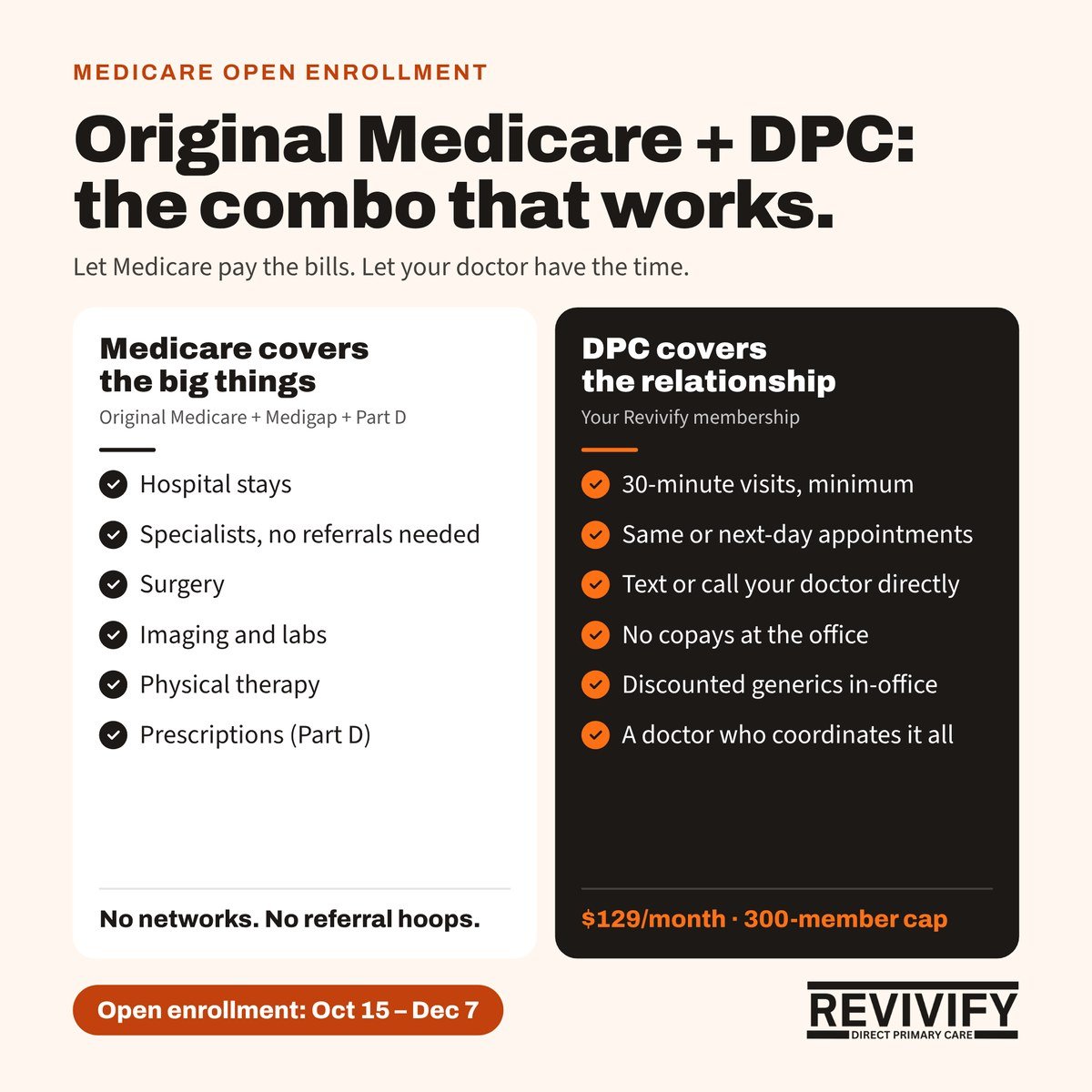
Here’s the idea behind pairing the two. Let Medicare cover what it covers best: hospitals, specialists, surgery, imaging, therapy and prescriptions. Then let a direct primary care membership cover the relationship: time, access and coordination.
Because Original Medicare has no networks and no referral requirements, nothing gets in the way. When I tell you to see a cardiologist, you call one. When I order labs, Medicare covers them at a Medicare lab. When I write a prescription, your Part D plan covers it.
What Direct Primary Care Adds
Here’s what changes when you add a DPC membership to Original Medicare:
- Time. Visits at Revivify start at 30 minutes and run as long as you need. Bring the whole list.
- Access. Same or next-day appointments, and you can text or call me directly. That question three days later? Text it.
- No office copays. Your membership covers your primary care visits. No 20% coinsurance at my office, no surprise bills.
- Discounted generics. Common generic medications are dispensed right in the office at discounted prices, often for less than a Part D copay.
- Discounted cash labs and imaging. Medicare still covers the tests I order at Medicare providers. For tests Medicare doesn’t cover, our negotiated cash prices are often a fraction of standard rates.
- A quarterback. I coordinate with your specialists, review their notes, help you make sense of results, and see you quickly after a hospital stay.
What It Looks Like Day to Day
Say you’re 71 and wake up with a swollen, painful knee. On Original Medicare alone, you’d call your doctor’s office, maybe get an appointment next week, maybe end up at urgent care.
With DPC, you text me a photo at 7 a.m. I see you that morning. If it needs imaging, I order it and Medicare covers it. If you need an orthopedist, I call one I trust, and Original Medicare means no referral paperwork stands in the way. Your Medigap plan picks up most of what Medicare doesn’t. You’ve spent one morning, not one week.
What It Costs
The DPC-friendly setup has three monthly costs on top of your Part B premium: a Medigap supplement, a standalone Part D plan, and your DPC membership ($129 a month at Revivify). That’s usually more per month than a $0-premium Medicare Advantage plan.
What you get in exchange is predictability and freedom. Medigap covers most of your outside costs, the membership covers primary care, and there are no networks to navigate. For a lot of people, especially those managing a few chronic conditions or who simply value their time, that trade is worth it. For others, it isn’t, and that’s a legitimate choice.
Who This Is For
This combination is a strong fit if you’re on Original Medicare or can switch to it, you can get a Medigap supplement at a reasonable price, and you want a doctor who knows you and is easy to reach. It’s especially valuable if you’re managing conditions like high blood pressure, diabetes or arthritis, or if you’re an active adult who wants a doctor focused on keeping you in the game.
FAQ: “Doesn’t Medicare Already Pay for Primary Care?”
It does, and if you’re happy with your current doctor, that may be all you need. DPC isn’t about getting primary care you can’t get otherwise. It’s about getting a different kind: more time, faster access and a doctor whose schedule isn’t built around billing codes.
The Revivify Difference
After 20 years caring for everyone from high school athletes to Olympians, I’ve learned that the relationship is the medicine. Revivify is capped at 300 members so every Medicare patient gets the kind of care I’d want for my own parents: unhurried, direct and coordinated.
What’s Next
Next up: a simple checklist to get ready before open enrollment opens on October 15. If you’re on Original Medicare and want to see how DPC would fit your life, learn about our membership or call us at 858-429-0099.
This post is for general education and isn’t insurance advice. Revivify doesn’t sell insurance, and direct primary care is not insurance.
← Back to all posts